

Blog
Mixed Emotion Tracksuit Comparison: How They Stack Up Against Traditional Tracksuits

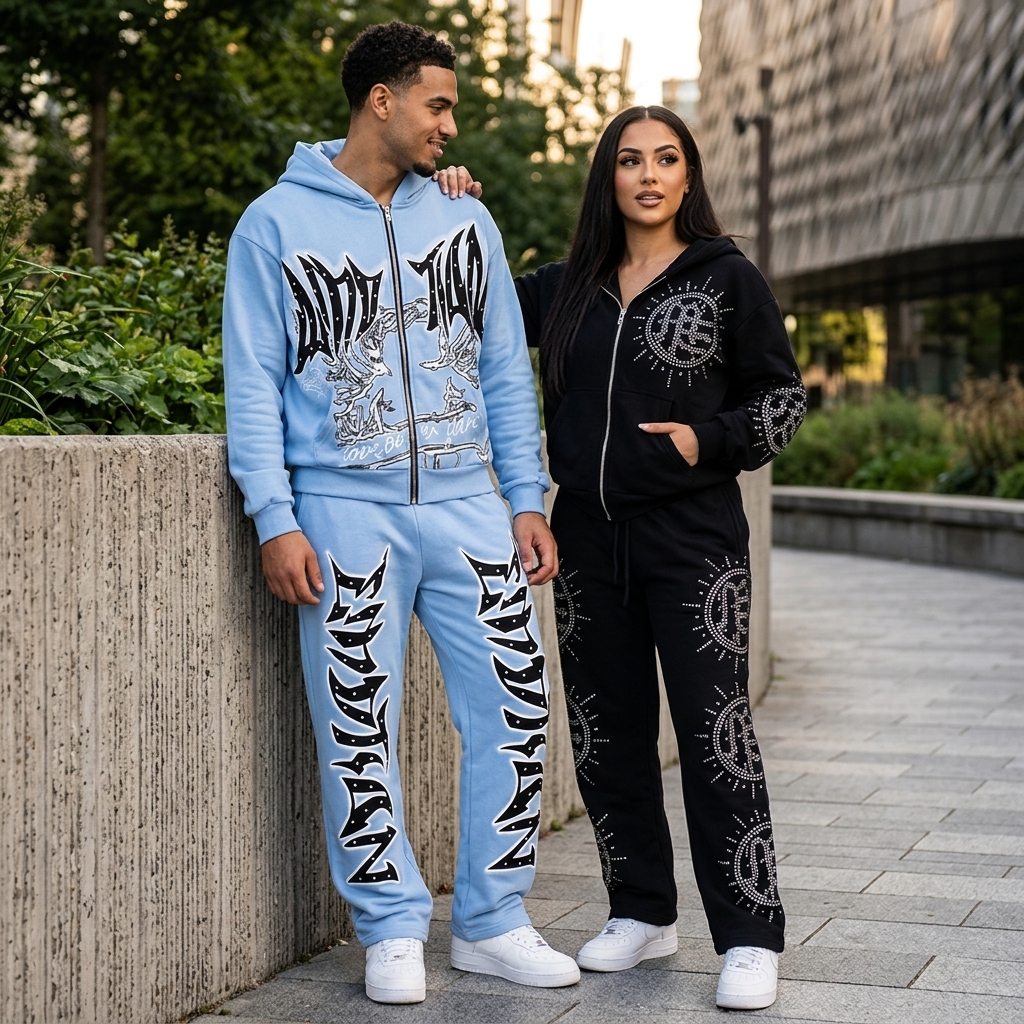
What actually separates a Mixed Emotion tracksuit from the polyester set you’d find at a sports store for $50? That’s the question this Mixed Emotion tracksuit comparison answers, piece by piece. On the surface, both are a jacket and matching pants. Look closer, though, and they differ in almost every way that matters: what the fabric is made of, how the graphics are applied, how the set fits, and what you pay per wear. I’ll compare each of those side by side, using real fabric weights and real prices, so you can decide which type of set actually suits how you dress. If you want the full rundown of the lineup first, start with our complete tracksuit guide. This page stays focused on the head-to-head. And I’ll be upfront: a traditional tracksuit genuinely wins in a couple of situations, and I’ll tell you which ones.
Fabric: Heavyweight Fleece vs Polyester and Cotton Tracksuits
Most traditional tracksuits are made from polyester tricot or nylon, the smooth, slightly shiny fabric you’d recognize from a warm-up suit. That fabric usually sits somewhere between 180 and 300 GSM (grams per square meter), which makes it light, quick-drying and good for sweating in. Streetwear sets go the other direction. Mixed Emotion builds its tracksuits from heavyweight fleece, the same family of fabric used in a thick hoodie, with a soft brushed inside that traps warm air. In the fleece world, anything above roughly 300 GSM counts as heavyweight, and that extra mass is what lets a set hold its shape instead of hanging limp. Here’s a quick test you can run on any set. Hold the jacket up by the shoulders. A light poly jacket collapses flat against itself, while a heavy fleece jacket keeps its outline, almost like someone is still wearing it. That structure is a big part of why fleece sets look like outfits rather than gym gear. The trade-off is breathability, since fleece runs warmer than poly and isn’t built for workouts. French terry, which has small loops inside instead of a brushed nap, sits in between: a little more breathable than fleece and a little less warm.
Graphics and Rhinestone Print Durability
Traditional tracksuits usually carry a small chest logo or a stripe down the sleeve and leg. That’s it. Mixed Emotion sets treat the whole garment as a canvas instead. On the Graffiti Series, the street-art typography runs continuously from the jacket down the pants, and on the Eclipse set, the crystal motif flows across both pieces too. The bigger question for most buyers is rhinestone print durability. Cheap bling sets often use thin, glued-on stones that pop off within the first few washes. Mixed Emotion heat-presses its rhinestones into the fabric, and the heavier fleece base gives each stone more to grip, which is why the sets hold up to cold, gentle washing. The Mixed Emotion Graffiti Rhinestone Tracksuit Set is a good example, since it layers crystal accents over a full graffiti print without the stones sitting loose on top. No rhinestone garment is indestructible, though. Heat from a dryer or an iron weakens the adhesive on any stone, no matter who made it.
Fit and Silhouette: Athletic Taper vs Relaxed Streetwear Cut
A classic tracksuit is cut for movement on a track: a fitted jacket, tapered pants and elastic cuffs at the wrists and ankles. That athletic shape looks right at practice, but it can look dated on the street. Mixed Emotion sets use a relaxed unisex silhouette instead, with room through the chest and a looser leg that falls over your sneakers. The difference matters for the graphics, too. On a tight cut, a big print stretches and distorts every time you bend your knee or reach forward. A relaxed cut gives the artwork room, so it keeps its shape while you move. Personally, I think the looser fit is the bigger upgrade of the two, even more than the fabric, because it’s what makes the set look current. It also lines up with the brand’s other pieces, since a Mixed Emotions hoodie from the hoodie collection uses the same chest sizing as the tracksuits.
Price and Cost-Per-Wear: Premium Two-Piece Sets vs Mass-Market
Here’s where traditional tracksuits look tempting. A basic polyester set from a mass-market brand often costs around $40 to $80, while Mixed Emotion’s premium two-piece sets currently run $160 to $180 on sale. That’s a real gap, so it helps to think in cost-per-wear instead of sticker price. Say you wear the $169 Graffiti Black twice a week for a year. That’s about 104 wears, or roughly $1.62 each time. Now picture a $50 set that pills, fades or loses its shape after 15 wears. That works out to about $3.33 per wear, double the cost, and you’re shopping again by spring. Those numbers are an example, not a promise, because how long any set lasts depends on how you wash it. Designer streetwear tracksuits from luxury houses, meanwhile, often cost several times what Mixed Emotion charges. So these sets sit in the middle: more than fast fashion, far less than luxury. For a deeper look at stitching and long-term wear, our honest quality review breaks it down, and if you only want the bottoms, the sweatpants collection is a cheaper way in.
Where a Traditional Tracksuit Still Wins
A Mixed Emotion set isn’t the right buy for everyone. If you need something to actually train in, polyester wins easily. It wicks sweat, dries fast and won’t overheat you on a run, while heavyweight fleece will. Traditional sets also pack smaller, so they’re better for a gym bag or a carry-on. Brushed fleece can pill over time too, especially where your arms rub your sides, and smooth poly mostly avoids that. One honest gap on our side: the product pages describe the fabric as heavyweight fleece but don’t list an exact GSM yet. If that number matters to you, contact support before ordering, or weigh the set when it arrives. Finally, if you prefer a quiet, logo-free look, the bold graffiti and crystal designs probably aren’t for you.
Mixed Emotion Tracksuit Comparison: The Verdict
So which one should you buy? If you want something to sweat in, grab a cheap polyester tracksuit and don’t overthink it. If you want a set you’ll wear out of the house, to class, on a flight or to dinner, a heavyweight fleece streetwear set wins on structure, design and long-term value. Within that category, Mixed Emotion stands out for its full-coverage graffiti art and heat-pressed rhinestones at a price well below designer labels. My advice is to treat it like a hoodie purchase, not a gym purchase, because that’s how you’ll actually wear it. When you’re ready to pick a design, our side-by-side ranking of the five sets shows which one fits your style. You can also browse the full tracksuit collection or explore more Mixed Emotion clothing to build around it.
Frequently Asked Questions
Is fleece or polyester better for a tracksuit?
Fleece is better for everyday streetwear because it’s warmer, softer and holds its shape. Polyester is better for workouts and hot weather, since it’s lighter and dries faster.
Do rhinestones on tracksuits fall off?
Cheaply glued stones often do. Heat-pressed rhinestones on a heavy base last much longer, as long as you wash cold, turn the set inside out and skip the dryer.
Why are streetwear tracksuits more expensive than regular ones?
You’re paying for heavier fabric, original artwork that covers the whole set, and detailing like rhinestones. Mass-market sets use lighter polyester and simple logos, which cost far less to make.
What does GSM mean for a tracksuit?
GSM means grams per square meter. Higher numbers mean thicker fabric, and fleece above about 300 GSM is generally considered heavyweight.